Photo Credit: Emily Williams
The conference I am attending is the UNFCCC COP20. This means the UN Framework Convention on Climate Change, 20th Conference of Parties. I’m attending as part of an awesome group of young people called SustainUS. I attended the Rio+20 Earth Summit with them a few years ago, and I’m excited to rejoin with a new group of passionate people.
This is to be honest a dream come true. I wanted to attend a meeting like this because it is a place where people come together to find real solutions and common purpose. It is a flawed process, but I hope to learn from that while here, learn more about environmental and justice policy, and make lasting connections. I have already met youth from more than a dozen countries. I also attended an international prep meeting with leaders of the top NGOs working towards issues I’m passionate about– I showed some courage and introduced myself and asked some questions.
If you know me, you know I care about environmental issues–hence the blank piece of paper I’m dragging along until I find a recycling bin or the grimace I give before quickly turning tight the off valve of a water faucet. I like to take action to lead by example and live my values. Here are the main reasons why:
- We have a moral obligation to protect our natural world. Everyone can think of their favorite landscape or waterway and why they like it clean. Religion also tells us to protect creation.
- It’s a problem for people, for pollution hurts peoples’ health. If you’ve ever gone for a jog along a busy street or wanted to swim in Lake Erie (or others), you know the impact on your body. And not surprisingly, the impacts fall most heavily on low-income and minority communities, and not by coincidence (a fact furthered by U of Michigan scholars!).
- We can do small things everyday, and when lots of people take small actions it makes a big difference. Some small actions you can take are saying “no thanks, I can carry it” to a store plastic bag, carrying a reusable mug, buying local food and products, filtering your own water instead of buying bottles, purchasing your next car as a hybrid or electric car, or investing your retirement money into socially responsible enterprises (called “divest and invest).
- Security risks are real and currently occurring. Some experts draw a connection between drought in eastern Africa and violent conflict in the Sudan exacerbated by water and food shortages. And war for oil is well documented. The more we can get away from extractive energy and the more we work to prevent the greenhouse effect, the safer we will be at home and abroad.
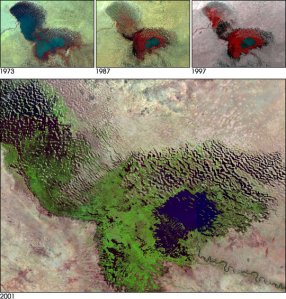
Photo Credit: NASA Earth Observatory http://earthobservatory.nasa.gov/IOTD/view.php?id=1240
- But the pollution is so severe, small actions are not enough. Industry and governments need to act to protect us. The most pollution by far comes from industry. Government regulations can be strengthened and companies can take steps to reduce their impact. But they have and will not take those actions with pressure. Governments represent the people, so organizing and running against incumbents is a possibility to get alternatives. As for industry, companies run off customers’ purchases and investments. Making strategic choices as consumers is a small step, but divesting (or taking out money) retirement funds and university endowments from fossil fuels can shift things.
Stay tuned to my updates from negotiations.
 Sarah Pendergast